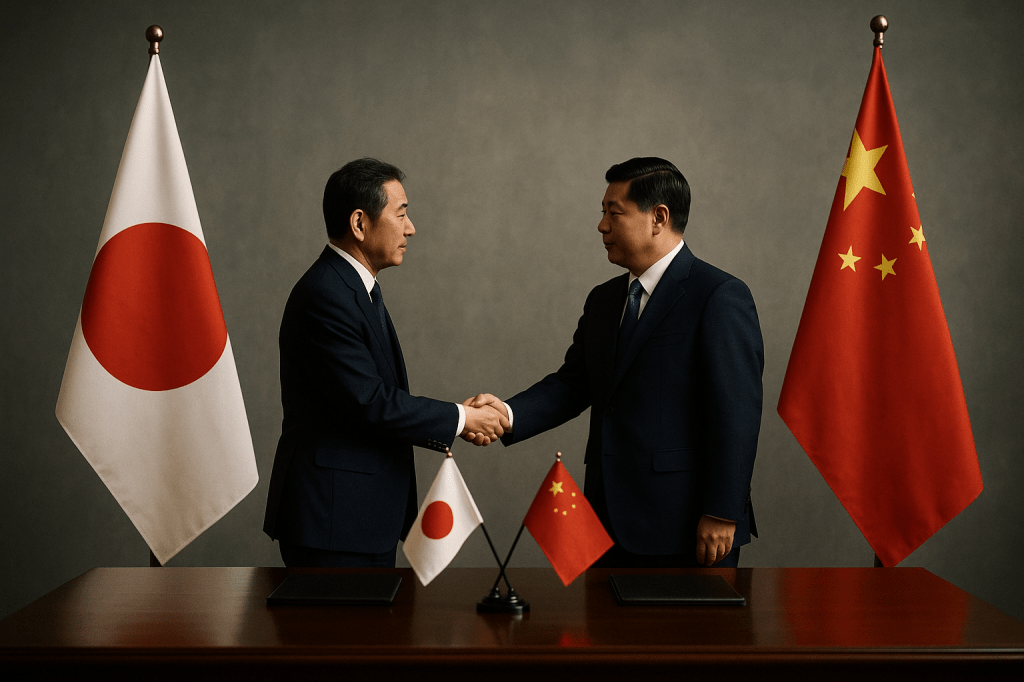
China–Japan Relations (1949-2022): Historical Evolution and Turning Points
From the end of the Second World War up to 2022, diplomatic, political, and military relations between the People’s Republic of China (PRC) and Japan have followed a highly fluctuating trajectory. This report analyzes the evolution of bilateral ties in four main phases, starting from the Cold War and proceeding to the post–Cold War power shift, China’s rise, and the more recent period marked by maritime disputes and strategic competition.
In each phase, we examine the foreign policy preferences and security doctrines of both sides, bilateral and multilateral diplomacy, top-level visits, major crises, and the military dimension. Particular attention is paid to key turning points such as the 1972 normalization, the 1978 Treaty of Peace and Friendship, the impact of Tiananmen, the re-emergence of historical memory issues, the Taiwan Strait crises, the Senkaku/Diaoyu Islands disputes, and the deepening of the U.S.–China–Japan strategic triangle. The narrative is chronological and analytical, and each period ends with a short timeline summarizing the major events.
1. 1949–1972: Non-Recognition, U.S. Influence, and the Taiwan Factor
Diplomatic Rupture at the Start of the Cold War
When Mao Zedong proclaimed the founding of the People’s Republic of China in 1949, Japan did not recognize the new government in Beijing. Instead, it continued to treat the Nationalist government (Republic of China) that had retreated to Taiwan as the legitimate representative of China. This “recognition crisis” was directly shaped by U.S. influence under Cold War conditions.
In 1951, Japan signed the San Francisco Peace Treaty (from which the PRC was excluded) and, immediately afterward, concluded a Security Treaty with the United States, thereby cementing itself as a U.S. ally. In 1952, Tokyo signed a separate peace treaty with the Nationalist government in Taipei, further sidelining the PRC. Washington’s strategy of isolating communist China heavily constrained Japan’s diplomatic room for maneuver.
In this context, the Taiwan issue became central for Sino–Japanese relations. As long as Tokyo recognized Taipei as the legitimate government of China, it could not form formal relations with Beijing. The PRC, for its part, condemned Japan for violating the “One China” principle and for maintaining an alliance with the United States, which Beijing saw as a potential military threat in East Asia.
Informal Contacts and Early Trade
Despite the lack of formal diplomatic relations, indirect trade and civil contacts between China and Japan began in the 1950s. In 1952, the two sides signed a first informal trade agreement through private sector and semi-official channels; subsequent protocols covered areas such as fisheries. These early initiatives, sometimes labeled “people’s diplomacy,” reflected the eagerness of Japanese business circles and opposition politicians to establish economic links with China despite U.S. restrictions.
Japanese governments, however, remained cautious at the official level. Conservative leaders in power viewed the communist regime with suspicion, fearing that closer ties with Beijing might jeopardize the U.S.–Japan alliance. For example, Prime Minister Nobusuke Kishi underscored his support for the Nationalists by visiting Taiwan in 1957, provoking sharp protests from Beijing.
In May 1958, an incident in Nagasaki further strained relations: Japanese right-wing activists desecrated a Chinese flag, causing outrage in China. Known as the “Nagasaki flag incident,” it led Beijing to suspend all ongoing limited trade and unofficial contacts with Japan. At the same time, Premier Zhou Enlai formulated the so-called “Three Political Principles” for the normalization of relations with Japan:
- Japan must cease anti-China activities.
- Japan must not participate in any attempt to create “Two Chinas” (i.e., treat Taiwan as a separate state).
- Japan must not obstruct the normalization of Sino–Japanese relations.
During the 1960s, some Japanese leaders showed greater interest in rapprochement, but no decisive progress was made. Prime Minister Eisaku Satō (1964–72) maintained official ties with Taiwan and refrained from recognizing the PRC.
From the Chinese perspective, Japan’s Security Treaty with the United States and the continued recognition of Taipei were grounds for deep distrust. In official rhetoric and media, Beijing criticized Japan’s alignment with the “imperialist camp,” while still allowing limited people-to-people trade and exchanges when conditions permitted.
The Road to Normalization and the U.S.–China Opening
A turning point came in 1971. The U.S. decision to open dialogue with China—symbolized by President Nixon’s visit to Beijing—sent shock waves through Tokyo. In October of the same year, the United Nations General Assembly transferred China’s seat from Taipei to Beijing. These developments signaled that isolating the PRC was no longer sustainable.
With Prime Minister Satō leaving office in 1972 and Kakuei Tanaka assuming power, Japan moved quickly. In September 1972, Tanaka led a high-level delegation to Beijing. On 29 September 1972, the two countries signed the Joint Communiqué of the Government of Japan and the Government of the People’s Republic of China, thereby formally establishing diplomatic relations.
In this historic document:
- Japan recognized the Government of the PRC as the sole legal government of China, effectively accepting the One China principle.
- The Chinese side declared that Taiwan is an inalienable part of the PRC.
- Japan stated that it understood and respected China’s position on Taiwan, and it did not challenge that claim.
- Tokyo severed official ties with Taipei.
The communiqué also addressed the past:
- Japan expressed deep remorse for the damage inflicted on the Chinese people during the war.
- China declared that it renounced all demands for war reparations from Japan.
By foregoing reparations, the PRC leadership aimed to open a new chapter in bilateral relations while also encouraging Japanese economic cooperation. In turn, Japan sought to turn the page on its militarist past in China through a combination of apology and economic support.
Normalization thus took place within a broader strategic context: U.S.–China détente, Sino–Soviet hostility, and Japan’s calculation that engagement with Beijing was now unavoidable and potentially beneficial.
Military and Strategic Dimension (1949–1972)
Between 1949 and 1972, the military dimension of Sino–Japanese relations remained largely indirect. Japan followed the Yoshida Doctrine, relying on the U.S. security umbrella and focusing on economic reconstruction and growth. The Self-Defense Forces, established under a pacifist constitution, were limited to defensive roles.
Japan’s main perceived threat during this period came from the Soviet Union, not China. Chinese military activities were centered on the Korean War and internal security matters rather than on any direct confrontation with Japan.
Nevertheless, Beijing viewed the U.S.–Japan alliance with suspicion. The presence of U.S. bases in Japan and the possibility that Japan might support U.S. military actions in Taiwan or elsewhere in East Asia were seen as latent threats. Chinese media and officials frequently criticized Japan’s security ties with Washington and warned against the revival of Japanese militarism.
No direct military clashes occurred between the two countries in this period, but deep mutual mistrust persisted beneath the surface.
Key Events, 1949–1972 (Chronology)
- 1949 – Founding of the People’s Republic of China; Nationalist government retreats to Taiwan. Japan continues to recognize Taipei as the government of China.
- 1951–52 – San Francisco Peace Treaty and U.S.–Japan Security Treaty signed; Japan concludes a separate peace treaty with the Republic of China (Taiwan). The PRC is excluded from these arrangements.
- 1950s – Informal trade agreements and limited people-to-people exchanges between China and Japan begin.
- 1957 – Prime Minister Nobusuke Kishi visits Taiwan, demonstrating support for the Nationalists; Beijing protests.
- 1958 – “Nagasaki flag incident”; China suspends trade and unofficial relations and articulates its “Three Political Principles” for normalization.
- 1960 – Renewal of the U.S.–Japan Security Treaty. Beijing criticizes the alliance as a threat to regional peace.
- 1971 – PRC obtains China’s UN seat; U.S.–China rapprochement (“Nixon shock”) dramatically alters Japan’s strategic calculations.
- 1972 – Prime Minister Kakuei Tanaka visits Beijing; Japan–PRC Joint Communiqué is signed (29 September). Tokyo recognizes the PRC as the sole legal government of China and severs official ties with Taiwan; China renounces claims to war reparations. Diplomatic relations are established.
2. 1972–1989: Normalization, Economic Rapprochement, and Political Caution
Consolidating Normalization: The 1978 Treaty of Peace and Friendship
After the 1972 normalization, Sino–Japanese relations entered a period of cautious optimism. The two countries reorganized their diplomatic ties and explored new areas of cooperation.
A major step came in 1978 when Prime Minister Takeo Fukuda and Chinese leader Deng Xiaoping concluded the Treaty of Peace and Friendship. This treaty:
- Legally reinforced the 1972 communiqué and the peaceful, cooperative nature of the relationship.
- Contained a clause opposing hegemony in Asia, widely understood at the time as a joint signal against Soviet expansionism.
Japan was initially hesitant about the “anti-hegemony” clause, fearing it might be seen as openly anti-Soviet, but eventually agreed. For China, long engaged in its rivalry with the USSR, the treaty symbolized a strategic understanding with Japan against Soviet dominance in the region.
Economic Rapprochement and Japanese ODA
The driving force in bilateral relations during this period was the economy. After deciding against war reparations, China encouraged Japan to support its modernization through economic cooperation.
In 1979, Japan launched its Official Development Assistance (ODA) program for China. Over the following decades, Japan provided large-scale loans, grants, and technical assistance, amounting to tens of billions of dollars. These funds helped to finance key infrastructure projects:
- Railways and ports
- Power plants and energy facilities
- Bridges, highways, and other major public works
Japanese ODA thus became a cornerstone of China’s “reform and opening” strategy under Deng Xiaoping. Japanese firms gained access to the Chinese market, exporting machinery, technology, and industrial equipment, while China exported raw materials and light industrial goods to Japan.
From Tokyo’s perspective, this economic engagement served several purposes:
- It symbolized a “substitute” for war reparations, easing historical guilt through economic contributions.
- It aligned with the Fukuda Doctrine of developing peaceful and cooperative relations with Asian neighbors.
- It allowed Japan to secure markets and resources in a rapidly evolving Chinese economy.
Politically, Japanese leaders embraced the notion of “seikei bunri”—the separation of politics and economics—hoping that economic ties would remain insulated from political disputes. The formula often described the reality of the time: “warm economics, cool politics.”
Political and Cultural Caution
Although diplomacy was generally smooth, the relationship remained fragile underneath. Several issues revealed underlying tensions, especially those related to historical memory and national identity.
In 1982, a major controversy erupted over Japanese history textbooks. A textbook approved by the Japanese Ministry of Education was criticized for downplaying atrocities such as the Nanjing Massacre. China reacted strongly, lodging official protests and triggering public anger. As a result, the Japanese government introduced guidelines pledging to show sensitivity towards the feelings of neighboring countries when approving textbooks.
Another flashpoint was the issue of visits to Yasukuni Shrine, which honors Japan’s war dead, including convicted war criminals. In 1985, Prime Minister Yasuhiro Nakasone paid an official visit to Yasukuni on 15 August, the anniversary of Japan’s surrender. China (and other Asian countries) condemned the visit. Faced with regional backlash, Nakasone refrained from repeating such visits in subsequent years.
Despite these tensions, top-level visits continued. High-ranking Chinese officials such as Zhao Ziyang and Hu Yaobang visited Japan in the early 1980s, delivering messages of friendship. Hu Yaobang emphasized youth exchanges and long-term people-to-people ties. In 1989, Crown Prince Akihito (later Emperor) visited China, becoming the first Japanese imperial family member to do so—an important symbolic gesture of reconciliation.
Security and Strategic Context
From 1972 to 1989, there were no direct military confrontations between China and Japan. Still, their security policies, alliances, and threat perceptions laid the groundwork for future issues.
Japan maintained its defensive security posture under the pacifist constitution, with self-imposed limits such as keeping defense spending around 1% of GDP. The principal military concern remained the Soviet Union’s forces in the Far East.
China, dealing with internal turmoil and external challenges, also perceived the Soviet Union as the main threat. The 1978 Treaty’s anti-hegemony clause reflected this shared concern. During the late 1970s, China even fought a brief war with Vietnam (1979), but this did not involve Japan.
Thus, the Soviet factor created an implicit strategic convergence: both Beijing and Tokyo saw Moscow’s presence in Asia as problematic. This convergence, combined with economic cooperation, helped keep the bilateral relationship relatively stable despite underlying mistrust.
Tiananmen and the End of the 1980s
The Tiananmen Square events in June 1989 were a turning point. The violent suppression of pro-democracy protests in Beijing prompted a wave of international condemnation and sanctions.
Japan joined other G7 countries in expressing concern and temporarily suspended new ODA loans and high-level political contacts with China. However, Tokyo was also the first among Western partners to soften its stance. By 1990, Japan began advocating a cautious re-engagement with China, arguing that isolating Beijing would be counterproductive.
This approach set the stage for later developments in the 1990s, including the historic visit of the Japanese Emperor to China.
Key Events, 1972–1989 (Chronology)
- 1972 – Japan–PRC Joint Communiqué; diplomatic relations established; Japan recognizes the PRC as the sole legal government of China and ends official relations with Taiwan. China renounces war reparations.
- 1978 – Treaty of Peace and Friendship signed and enters into force. Anti-hegemony clause signals shared concern over Soviet influence. Deng Xiaoping visits Japan, boosting economic and technological cooperation.
- 1979 – Japan officially launches its ODA program for China, providing large-scale low-interest loans and grants that finance major infrastructure projects.
- 1982 – Textbook controversy over the depiction of wartime atrocities; China protests sharply. Japan promises to consider the feelings of neighboring countries in textbook screening.
- 1984–85 – High-level visits: Hu Yaobang and Yasuhiro Nakasone exchange visits; Nakasone’s 1985 Yasukuni visit triggers Chinese protests and fuels suspicions.
- 1989 – Tiananmen Square crackdown; Japan suspends new loans and reduces high-level contacts, but soon takes a leading role in cautiously re-engaging with China.
3. 1990–2008: China’s Rise, Historical Memory, Taiwan, and Security Tensions
Post–Cold War Power Shift
With the end of the Cold War and the dissolution of the Soviet Union, the strategic environment in East Asia changed dramatically. The common Soviet threat diminished, but a new dynamic emerged: China’s rapid rise and Japan’s relative stagnation.
In the 1990s, China’s economy grew at near double-digit rates, while Japan endured its “lost decade” with sluggish growth. Over time, China approached—and eventually overtook—Japan in economic size (surpassing it in 2010 to become the world’s second-largest economy). This shift fundamentally altered regional power balances and strategic perceptions.
Japan began to worry about China’s expanding political, economic, and military influence. Meanwhile, China’s leadership viewed Japan with a mix of economic pragmatism and historical suspicion, wary of Tokyo’s intentions and its U.S. alliance.
Symbolism and Friction in the 1990s
In 1992, on the 20th anniversary of normalization, Emperor Akihito paid a historic visit to China—the first visit by a Japanese emperor. His expressions of “deep remorse” for the suffering caused during the war were generally well received in China, reinforcing reconciliation efforts.
At the same time, new frictions appeared. Japan showed interest in a permanent seat on the UN Security Council, but China remained reluctant to support this, citing concerns that Japan had not fully come to terms with its wartime past. Chinese leaders used historical issues as leverage in debates over Japan’s quest for greater international status.
In 1995, on the 50th anniversary of the end of the war, Prime Minister Tomiichi Murayama issued a landmark statement acknowledging “colonial rule and aggression” and expressing “deep remorse and heartfelt apology” for the suffering inflicted on Asian peoples. China welcomed this as an important step.
However, the visit of Chinese President Jiang Zemin to Japan in 1998 highlighted the limits of reconciliation. Jiang repeatedly raised wartime history and pressed for a written apology in terms stronger than Japan was willing to accept. The visit ended without the symbolic closure Beijing had hoped for, leaving both sides somewhat dissatisfied.
The Rise of Nationalism and Historical Memory Conflicts
Throughout the 1990s and 2000s, historical memory remained one of the most explosive issues in bilateral relations.
Repeated controversies over history textbooks in Japan, visits by Japanese politicians to Yasukuni Shrine, and statements perceived as justifying or minimizing Japan’s wartime aggression triggered frequent protests in China.
In both countries, nationalism gained strength. In China, the Communist Party increasingly relied on nationalist narratives—particularly anti-Japanese sentiment—to bolster its domestic legitimacy. State-sanctioned patriotic education and media coverage emphasized Japan’s past aggression and the need for vigilance.
The situation escalated in 2005, when a new Japanese history textbook perceived as revisionist, combined with Prime Minister Junichiro Koizumi’s repeated visits to Yasukuni, sparked mass anti-Japanese demonstrations across China.
In April 2005:
- Tens of thousands of protesters took to the streets in major cities such as Beijing, Shanghai, Guangzhou, and Shenzhen.
- Japanese embassies and consulates were attacked with stones; Japanese restaurants, shops, and vehicles became targets of vandalism.
- Slogans demanded that Japan “face up to history,” opposed Tokyo’s bid for a permanent UN Security Council seat, and referred to the disputed Senkaku/Diaoyu Islands.
Protests reached levels not seen since 1989, and relations fell to their lowest point since normalization. While Chinese authorities initially allowed demonstrations—seeing them as a controlled outlet for public anger—they later reined them in to prevent instability.
In Japan, these events reinforced negative perceptions of China and fueled debates over how to respond to pressure rooted in historical grievances.
Taiwan and Security Tensions
Taiwan was another critical, though often implicit, source of tension. Since 1972, Japan had no official ties with Taipei, but it viewed stability in the Taiwan Strait as vital to its own security.
The 1995–96 Taiwan Strait Crisis, during which China conducted missile tests and military exercises near Taiwan, drew the attention of Tokyo. The crisis prompted the U.S. and Japan to rethink their security cooperation:
- In 1997, they revised the U.S.–Japan Defense Guidelines, introducing the concept of cooperation in “situations in areas surrounding Japan.”
- While intentionally vague, this wording clearly encompassed contingencies in the Taiwan Strait.
Beijing strongly opposed these changes, warning Japan not to interfere in China’s internal affairs and not to support U.S. operations related to Taiwan.
In 2005, U.S. and Japanese officials issued a joint statement listing the “peaceful resolution of issues concerning the Taiwan Strait” as a “common strategic objective.” For the first time since 1969, Taiwan was explicitly mentioned in a major U.S.–Japan security document. China condemned this as a violation of its sovereignty.
That same year, China adopted the Anti-Secession Law, authorizing the use of “non-peaceful means” should Taiwan formally declare independence. The law alarmed both Taipei and Tokyo and heightened perceptions of the risk of conflict.
Emerging Friction in the East China Sea
Another potential flashpoint was the East China Sea, especially the area around the Senkaku/Diaoyu Islands. Although sovereignty over these uninhabited islands had been disputed since the 1970s, both sides had previously preferred to “shelve” the issue.
In 1992, China enacted its Territorial Sea Law, which explicitly included the Diaoyu Islands as part of its territory. Japan rejected this claim.
In the late 1990s and early 2000s:
- Japanese nationalist groups built symbolic structures (such as a lighthouse) on one of the islands.
- Chinese activists repeatedly attempted to land on the islands to assert China’s claim.
- A Chinese nuclear submarine intruded into Japanese waters in 2004, prompting a Japanese maritime response.
While these incidents did not escalate into full-scale crises at the time, they underscored the growing volatility of the maritime dispute.
Chinese Military Modernization and Japanese Strategic Shifts
From the 1990s onward, China embarked on a comprehensive military modernization program:
- Defense budgets grew at double-digit rates.
- The navy and air force modernized, improved missile capabilities, and expanded their operational reach.
Japan watched these developments with increasing concern, especially as Chinese forces became more active in the East and South China Seas.
In response, Japan gradually revised its security doctrine:
- By the late 1990s and early 2000s, official defense documents started highlighting China’s military modernization and lack of transparency.
- Japan shifted attention from the northern front (Soviet/Russian threat) to “new threats” and “regional uncertainties,” implicitly referring to China (and North Korea).
Under Prime Minister Shinzo Abe (first term, 2006–2007), Japan began to debate the idea of becoming a more “normal” military power. Abe advocated a more proactive security role, reinterpretation (and eventually revision) of the pacifist constitution, and stronger defense cooperation with allies, particularly the United States.
The U.S.–Japan alliance deepened. Washington encouraged Tokyo to play a more assertive role in regional security, including:
- Missile defense cooperation.
- Base realignment and expanded training.
- Political support for maintaining freedom of navigation and overflight in regional seas.
From Beijing’s perspective, these moves looked like elements of a containment strategy.
Diplomatic Efforts and Thaw (2006–2008)
After years of tension under Koizumi, relations began to thaw when Shinzo Abe became prime minister in 2006. Determined to repair ties with China, Abe made his first overseas trip as prime minister to Beijing in October 2006—an initiative widely described as “ice-breaking diplomacy.”
In 2007, Chinese Premier Wen Jiabao visited Tokyo in what was dubbed the “ice-melting” visit, signaling further improvement.
In May 2008, Chinese President Hu Jintao visited Japan, the first state visit by a Chinese head of state in a decade. Hu and Prime Minister Yasuo Fukuda issued a joint statement pledging to build a “mutually beneficial relationship based on common strategic interests.” The two sides agreed to:
- Look squarely at history while focusing on the future.
- Cooperate for peace and prosperity in Asia.
- Manage disputes through dialogue and expand economic and cultural ties.
In October 2008, Prime Minister Taro Aso visited Beijing for the 30th anniversary of the Treaty of Peace and Friendship. He called for moving beyond “narrow friendship” to a relationship of healthy competition and active cooperation.
Despite this positive rhetoric, fundamental issues—territorial disputes, historical grievances, and strategic distrust—remained unresolved beneath the surface.
Key Events, 1990–2008 (Chronology)
- 1992 – Emperor Akihito visits China, expressing deep remorse for Japan’s wartime actions. China responds positively, but disputes over Japan’s bid for a UNSC permanent seat emerge.
- 1995 – Murayama Statement: official apology for colonialism and aggression; China welcomes the statement. The Taiwan Strait Crisis (1995–96) draws Japanese attention to security risks.
- 1997 – Revised U.S.–Japan Defense Guidelines expand cooperation in “areas surrounding Japan,” implicitly including Taiwan contingencies.
- 1998 – President Jiang Zemin’s visit to Japan ends on a strained note due to disagreements over history and apologies.
- 2001–2006 – Prime Minister Junichiro Koizumi visits Yasukuni Shrine annually; China suspends top-level summits, causing a “cold politics, hot economics” phase.
- 2004 – Chinese nuclear submarine incursion into Japanese waters; rising concerns over Chinese military activities.
- 2005 – Mass anti-Japanese protests across China over textbooks, Yasukuni, and Japan’s UNSC bid; relations reach their lowest point since 1972. U.S.–Japan joint statement mentions Taiwan; China adopts the Anti-Secession Law.
- 2006 – Shinzo Abe’s “ice-breaking” visit to Beijing restores top-level dialogue.
- 2007 – Wen Jiabao’s “ice-melting” visit to Tokyo strengthens reconciliation.
- 2008 – President Hu Jintao’s visit to Japan; joint declaration on a mutually beneficial relationship based on common strategic interests. Aso attends celebrations of the 30th anniversary of the Treaty of Peace and Friendship.
4. 2008–January 2022: Senkaku/Diaoyu Crises, Strategic Competition, QUAD, and the U.S.–China–Japan Triangle
The Senkaku/Diaoyu Islands Crisis (2010–2012)
The 2010s saw the Senkaku/Diaoyu Islands dispute move to the center of Sino–Japanese tensions, with escalating maritime and air confrontations.
In September 2010, a Chinese fishing trawler collided with Japanese Coast Guard vessels near the Senkaku Islands. The Japanese authorities detained the captain and crew, accusing the trawler of deliberately ramming the patrol boats.
China reacted strongly:
- It demanded the immediate and unconditional release of the captain.
- It suspended high-level contacts and threatened economic retaliation.
- Exports of rare earth elements to Japan were sharply curtailed, signaling Beijing’s willingness to use economic leverage.
Under intense diplomatic and domestic pressure, Japan eventually released the captain. But China insisted on an apology, and the episode left deep scars. In Japan, the government was criticized for appearing weak; in China, the incident was portrayed as a victory of firm resolve over Japanese “provocation.”
A far more serious escalation came in 2012. Tokyo Governor Shintaro Ishihara, a nationalist figure, campaigned to purchase privately owned Senkaku islands on behalf of the Tokyo metropolitan government. To preempt this local initiative, the central government of Prime Minister Yoshihiko Noda decided to buy the islands itself.
On 11 September 2012, Japan officially “nationalized” three of the islands by purchasing them from their private owners. Although the Japanese government argued that this move was intended to maintain stability and prevent more provocative actions by local actors, Beijing saw it as a unilateral change in the status quo and a direct challenge to China’s sovereignty claims.
China’s response was severe:
- Chinese government vessels began regular patrols in waters near the islands.
- Numerous incursions into what Japan considers its territorial sea occurred.
- Chinese media and officials adopted a sharply confrontational tone.
Domestically, the move triggered massive anti-Japanese protests across China:
- In more than 80 cities, tens of thousands took to the streets in mid-September 2012.
- Japanese businesses, factories, and vehicles were attacked; some facilities were set on fire.
- Protesters called for boycotts of Japanese goods, denounced Japan’s purchase of the islands, and displayed nationalist slogans.
The 2012 protests were among the largest anti-Japanese demonstrations since 2005. Chinese authorities let them run for a time but eventually clamped down to prevent chaos.
In strategic terms, the crisis fundamentally altered the operational environment in the East China Sea. Chinese coast guard and maritime law-enforcement ships began routine patrols near the islands, sometimes entering the 12-nautical-mile territorial sea claimed by Japan.
Japan responded by:
- Increasing the presence and capabilities of its Coast Guard.
- Intensifying surveillance and patrols around the islands.
- Highlighting the dispute in diplomatic contacts with the United States and other partners.
From this point onward, the Senkaku/Diaoyu issue became a chronic source of friction and risk.
China’s ADIZ and Heightened Military Risks
In November 2013, China declared an Air Defense Identification Zone (ADIZ) over a wide area of the East China Sea, including the airspace above the Senkaku/Diaoyu Islands.
China announced that all aircraft entering the ADIZ would be required to submit flight plans and follow Chinese instructions, under threat of “defensive emergency measures.” Japan, the United States, and South Korea refused to recognize the ADIZ.
The U.S. sent B-52 bombers through the zone without prior notification. Japan instructed its civilian airlines not to submit flight data to China for flights through the area.
As a result, military and civilian aircraft from both sides operated in increasingly crowded airspace, raising the risk of accidents or miscalculation. Japanese fighter jets scrambled more frequently to intercept Chinese aircraft approaching or entering the ADIZ.
In parallel, at sea, incidents such as a Chinese warship reportedly locking fire-control radar onto a Japanese vessel (in early 2013) underscored how close the two countries were to potential armed clashes.
Abe’s Second Term and Renewed Tensions
Shinzo Abe returned to power in December 2012, just months after the Senkaku nationalization. While he pursued economic reforms (“Abenomics”), he also sought to reshape Japan’s security posture, moving towards a more assertive defense policy.
In December 2013, Abe visited Yasukuni Shrine, provoking strong protests from China and South Korea and criticism from the United States. Beijing effectively refused to hold a summit with Abe for nearly two years.
Only in November 2014, on the sidelines of the APEC summit in Beijing, did President Xi Jinping and Abe meet for the first time. The encounter was tense—photographs showed both leaders with unsmiling faces—but it marked the reopening of high-level communication.
Prior to the meeting, both sides quietly reached a four-point consensus that:
- Acknowledged disagreements over the Senkaku/Diaoyu issue but agreed to manage them and avoid escalation.
- Committed to setting up a maritime and air communication mechanism to prevent incidents.
Although this consensus reduced immediate risks, it did not resolve underlying disputes.
Regional Strategic Competition and the QUAD
As China’s power expanded, Japan sought to strengthen ties with other regional partners beyond the United States. The result was increasingly visible regional strategic competition:
- Japan deepened security ties with Australia and India.
- It provided coast guard vessels and equipment to Southeast Asian countries wary of China’s maritime ambitions.
- It promoted the concept of a “Free and Open Indo-Pacific,” underscoring the need for rules-based order and freedom of navigation.
A key element in this strategy was the Quadrilateral Security Dialogue (QUAD), an informal grouping of the United States, Japan, Australia, and India.
Initially floated in 2007 during Abe’s first term, the QUAD faded when Australia withdrew. It was revived in 2017, as U.S.–China competition intensified.
The QUAD is not a formal military alliance, but Beijing has consistently criticized it as an attempt to encircle China and likened it to an “Asian NATO.” Japan’s leadership sees the QUAD as a way to anchor cooperation among like-minded democracies in the Indo-Pacific region.
The U.S.–China–Japan Triangle
The broader frame for Sino–Japanese relations since the 2010s has been the intensifying rivalry between the United States and China.
Japan has:
- Firmly anchored itself in the U.S. camp on security issues.
- Supported U.S. freedom-of-navigation operations and criticized China’s militarization of the South China Sea.
- Participated in joint statements and initiatives that highlight concerns about China’s behavior.
At the same time, Japan remains economically interdependent with China, which is its largest trading partner. This creates a delicate balancing act: Tokyo must manage security competition with Beijing without undermining its own economic interests.
The Trump administration’s trade war and technology restrictions on China complicated this balancing act. Japan attempted to align with the United States on key strategic concerns while avoiding unnecessarily severe economic fallout for Japanese companies deeply exposed to the Chinese market.
Taiwan Re-enters the Open Agenda
Perhaps the most significant shift in the late 2010s and early 2020s was the way Taiwan returned to the center of strategic debates. Beijing increased military pressure on Taiwan through frequent air and naval patrols, while U.S. support for Taipei grew more explicit.
Japan, for decades cautious about mentioning Taiwan in official documents, began to speak more openly:
- In April 2021, Prime Minister Yoshihide Suga and U.S. President Joe Biden issued a joint statement underscoring the importance of peace and stability in the Taiwan Strait—the first explicit reference to Taiwan in a U.S.–Japan leaders’ statement since 1969.
- Japanese defense white papers in 2021 highlighted the link between Taiwan’s security and Japan’s own security, effectively signaling that a crisis over Taiwan would directly concern Japan.
China reacted sharply, accusing Japan of interfering in its internal affairs and warning Tokyo against “crossing red lines.”
The legal and doctrinal shift that enabled Japan to play a more active role also matters. In 2015, the Japanese Diet passed new security laws allowing limited exercise of the right of collective self-defense, meaning that Japan could use force in defense of allies under certain conditions. While carefully circumscribed, this opened the door, at least in principle, to Japanese involvement in a Taiwan contingency alongside the United States.
From Beijing’s vantage point, this evolution underscored the risk that a Taiwan conflict might draw in Japan and transform into a broader regional war.
Japan’s Evolving Defense Posture
In the 2010s, Japan undertook a significant reorientation of its defense posture:
- The 2010 National Defense Program Guidelines shifted focus from the northern to the southwestern theater, emphasizing the defense of the Nansei Islands (Okinawa and the Ryukyu chain) close to Taiwan and the East China Sea.
- Japan deployed new units, radar stations, and anti-ship and surface-to-air missile batteries on islands such as Yonaguni, Amami Oshima, Miyakojima, and Ishigaki.
- The goal was to monitor and, if necessary, counter Chinese naval movements and protect sea lanes.
China, meanwhile, continued to modernize its forces under Xi Jinping:
- It commissioned its first aircraft carrier (Liaoning) and then a second.
- It expanded its submarine and surface fleets, increased long-range missile capabilities, and conducted more far-sea exercises.
- It strengthened the China Coast Guard and, in 2021, adopted a Coast Guard Law authorizing the use of force in certain circumstances against foreign vessels in waters China claims.
China’s more assertive behavior in the East and South China Seas, including the ADIZ and coast guard law, was widely seen in Japan as evidence that Beijing aimed to change the status quo by coercive means.
Attempts at Diplomatic Stabilization
Despite growing strategic rivalry, both sides also took steps to manage tensions and stabilize relations.
In 2018, on the 40th anniversary of the Treaty of Peace and Friendship, Prime Minister Abe visited Beijing. The two sides signed numerous cooperation agreements, especially in economic fields and third-country infrastructure projects.
They agreed to launch and expand a maritime and air communication mechanism to prevent accidental clashes in the East China Sea.
In 2019, Xi Jinping visited Japan for the G20 summit, and both sides planned a full-fledged state visit by Xi in 2020, which would have symbolized a further thaw.
However, the outbreak of COVID-19 and the crackdown in Hong Kong disrupted this trajectory. Xi’s planned state visit was postponed indefinitely. Japan joined Western partners in expressing concern over Hong Kong’s new National Security Law, further complicating the political climate.
Even so, economic ties remained robust, and both governments recognized the mutual benefits of avoiding uncontrolled escalation. Regular consultations between foreign and defense officials were maintained.
Situation as of January 2022
By January 2022, the overall picture of China–Japan relations could be summarized as follows:
- Deep economic interdependence and extensive trade and investment flows.
- Persistent strategic rivalry and profound mutual distrust in security matters.
- Unresolved disputes over:
- The Senkaku/Diaoyu Islands and surrounding waters.
- The future of Taiwan and the extent of possible Japanese involvement in a Taiwan conflict.
- Historical memory and national identity, especially wartime issues.
Public opinion in both countries remained largely negative. Surveys consistently showed that large majorities in both Japan and China held unfavorable views of the other country, reflecting deeply rooted suspicions and historical grievances.
Yet, decades of experience have also produced a certain “learned diplomacy”—mechanisms and habits aimed at preventing crises from spiraling out of control. Both leaderships understand that an open military clash would be catastrophic, not only for bilateral relations but for the entire region and global economy.
The challenge, as of January 2022, is whether China and Japan can manage their rivalry and find a way to coexist peacefully, especially as:
- U.S.–China competition intensifies.
- Taiwan becomes an increasingly salient issue.
- Military capabilities on both sides continue to grow, especially in the maritime and air domains around the East China Sea and Taiwan.
Key Events, 2008–January 2022 (Chronology)
- 2010 – Collision between a Chinese trawler and Japanese Coast Guard vessels near the Senkaku Islands; detention of the Chinese captain triggers a major diplomatic crisis and suspected rare earth export restrictions by China.
- 2012 – Japan nationalizes three of the Senkaku Islands; huge anti-Japanese protests erupt in China; Chinese government vessels begin regular patrols near the islands; relations plummet.
- 2013 – China declares an East China Sea ADIZ including the Senkaku airspace; Japan and the U.S. refuse to recognize it; air and maritime encounters increase. Abe visits Yasukuni Shrine, prompting harsh Chinese criticism.
- 2014 – First Abe–Xi meeting on the sidelines of the APEC summit in Beijing; a four-point consensus is reached to manage tensions.
- 2015 – Japan passes new security laws allowing limited exercise of collective self-defense; U.S.–Japan defense guidelines are updated. China criticizes Japan’s “remilitarization.”
- 2016–2017 – Japan fortifies its southwestern islands with new units and radars; the QUAD is revived as a strategic forum with the U.S., Australia, and India.
- 2018 – Abe visits Beijing; 40th anniversary of the Treaty of Peace and Friendship; multiple agreements signed to improve ties and launch crisis-prevention mechanisms.
- 2019 – Xi visits Japan for the G20; preparations begin for a future state visit.
- 2020 – COVID-19 pandemic and the Hong Kong security law derail plans for Xi’s state visit; Japan voices concern over Hong Kong and cautiously aligns with Western criticism.
- 2021 – Suga–Biden joint statement explicitly mentions Taiwan; Japanese defense documents stress the link between Taiwan’s security and Japan’s. China warns Japan against crossing red lines. Chinese coast guard law enters into force, authorizing use of force in waters Beijing claims; Japanese concerns about the East China Sea heighten.
- January 2022 – Diplomatic channels remain open and both sides express the desire to mark the 50th anniversary of normalization positively, but structural tensions over Taiwan, the East China Sea, and military competition remain unresolved.
Conclusion
From 1949 to January 2022, Sino–Japanese relations have evolved from non-recognition and Cold War hostility to diplomatic normalization, economic interdependence, and, ultimately, strategic rivalry. Economic ties and mutual dependence are deep, yet political and security relations remain fragile and contested.
The U.S.–China rivalry, the unresolved Taiwan question, the Senkaku/Diaoyu dispute, and historical memory issues form the main axes of tension. While both sides have repeatedly shown an ability to pull back from the brink and re-engage through diplomacy, their relationship is now framed by an increasingly competitive regional and global environment.
Whether China and Japan can build a stable framework for competitive coexistence—managing disputes without military conflict while maintaining cooperation where interests converge—will be a central factor shaping the future of East Asia and the broader international order.

 Ahmet Tümer