Introduction
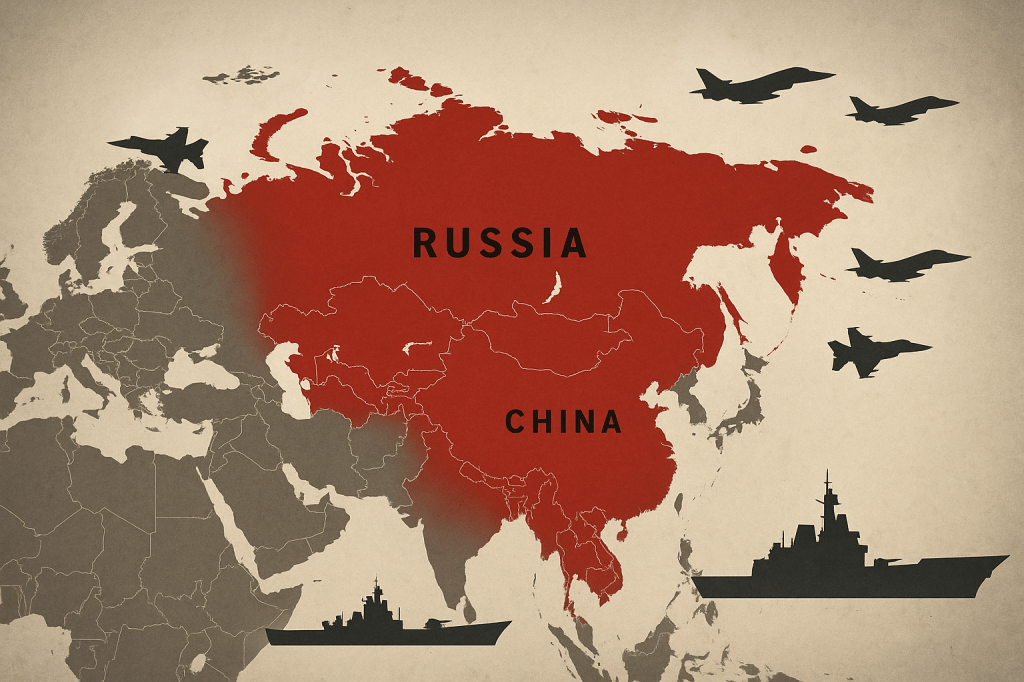
Over the five-year period from 2018 to September 2023, the People’s Republic of China and the Russian Federation have conducted a series of extensive joint military exercises, elevating their security cooperation to an unprecedented level. These exercises, which have the potential to alter the post–Cold War balance of power, have offered both countries an opportunity to demonstrate their military capabilities and intentions on a global scale. As the size of the exercises, the diversity of forces involved, and their geographical reach have steadily expanded, the geopolitical messages they convey have also become more explicit.
This report analyzes, with an analytical approach, the military dimensions of the major exercises carried out jointly by China and Russia in this period, the strategic signals they have sent, and their regional effects stretching from the Asia-Pacific to Central Asia and Europe. By evaluating the timing, geographical location, scope of the exercises, and international reactions, it seeks to reveal how this rapprochement is reflected in the architecture of global security.
Military Dimension and Scope of the Exercises
Vostok-2018 Exercise (September 2018)
The Vostok-2018 (East-2018) strategic exercise, held by Russia on 11–17 September 2018, was announced as the largest military exercise since the Soviet Union’s Zapad maneuvers of 1981. According to official statements, the plan called for the participation of 300,000 Russian troops, 36,000 armored vehicles, and more than 1,000 aircraft, aiming at an unprecedented show of force on Russian territory. Even though actual participation turned out somewhat smaller, the most striking aspect of this exercise was the inclusion of China for the first time.
The People’s Liberation Army (PLA) joined Vostok-2018 with approximately 3,200 personnel, 900 armored vehicles, and 30 combat aircraft, making it the first foreign force to take part in a Russian domestic strategic exercise in the post-Soviet era. The exercise was conducted across Siberia and Russia’s Far East and included large-scale combat scenarios against a force modeled on NATO. Chinese units deployed alongside Russian forces at the Tsugol training range, carrying out joint missions such as air–ground coordination, airborne operations, and artillery fire support.
Vostok-2018 tested the Russian army’s command-and-control capabilities, while for China it offered the opportunity to observe Russia’s combat experience in Syria and gain practice in large-scale joint operations. At the same time, this massive exercise signaled that Moscow and Beijing no longer regarded each other as direct threats but were instead prepared to act together against a common adversary—represented in the scenario by “Western” forces.
Tsentr-2019 Exercise (September 2019)
Held on 16–21 September 2019 in Russia’s Orenburg region and on ranges in Central Asia, the Tsentr-2019 (Center-2019) exercise stood out with its multinational participation. Russia joined the exercise with around 128,000 troops, while China, India, Pakistan, Kazakhstan, Kyrgyzstan, Tajikistan and Uzbekistan—members of the SCO/CSTO framework—also took part.
The PLA deployed around 1,600 troops from the Western Theater Command, along with Type-96A main battle tanks, J-11 fighter jets, JH-7A fighter-bombers, H-6K strategic bombers, Z-10 attack helicopters, and Y-9 and Il-76 transport aircraft. Notably, the Chinese Air Force used live munitions on Russian soil for the first time, with H-6K strategic bombers striking ground targets; 23 Chinese aircrews took part in the joint operations.
Although the exercise was officially framed around counter-terrorism, a significant portion of the scenario focused on repelling a conventional enemy state and conducting large-scale counter-offensive operations. In this sense, Tsentr-2019 went beyond a counter-terrorism drill in Central Asia and functioned as a rehearsal for joint warfare by major powers. The exercise’s multinational character showed that Moscow and Beijing could assume a leadership role in the region’s security architecture, while the presence of both India and Pakistan under the same umbrella symbolized the search for geopolitical balance by two rival powers within the Russia–China axis.
Kavkaz-2020 Exercise (September 2020)
In September 2020, despite the constraints of the COVID-19 pandemic, Russia conducted the Kavkaz-2020 (Caucasus-2020) exercise as part of its annual series of strategic drills. After holding six joint exercises with China in 2019, the Moscow–Beijing duo was able to come together in person only for this exercise in 2020, the pandemic year.
The exercise was carried out in Russia’s Southern Military District, particularly around the Kapustin Yar range in Astrakhan, and included scenarios spanning the South Caucasus and the Caspian basin. China participated by sending units from the 76th Group Army of the Western Theater Command. Armenia, Belarus, Myanmar and Pakistan were also invited, giving the exercise a distinctly multinational character.
Since 2018, Russia has started to include not only Belarus but also China and several other partner states in its strategic-level exercises, which reflects Moscow’s growing confidence in Beijing. However, Chinese forces’ involvement in Kavkaz-2020 was largely limited to show-of-flag roles and restricted joint operations. In several sensitive phases where new tactical concepts were tested, the Russian army chose to proceed without Chinese observers. This indicates that, despite deeper cooperation, Moscow still feels the need to safeguard some of its strategic secrets.
Zapad/Interaction-2021 Exercise (August 2021)
Held on 9–13 August 2021 in China’s Ningxia Hui Autonomous Region and known in Chinese sources as “Xibu/Lianhe-2021” (West/Interaction-2021), this exercise marked a milestone as the first joint military drill conducted on Chinese soil by China and Russia. Roughly 10,000–13,000 troops from the PLA Western Theater Command and the Russian Eastern Military District participated.
The scenario, under the theme of “maintaining regional security and stability,” focused on testing capabilities for joint reconnaissance, early warning, electronic warfare and target neutralization through combined firepower. Strikingly, Russian troops used modern Chinese weapons and equipment during the exercise; systems such as the newly introduced Type-95 integrated air-defense missile system were operated by Russian soldiers.
For its part, China for the first time deployed J-20 stealth fighter jets and Y-20 strategic transport aircraft in an exercise, while the Russian Air Force participated with Su-30 fighter jets. Deep integration was achieved in command and control: a three-tier, bilingual (Chinese–Russian) joint command center was established for the exercise, along with real-time intelligence-sharing networks.
The operational phase of the exercise was planned in four stages: detection and neutralization of enemy forces and positions; breaking the defense line through intense artillery and air bombardment; deep offensive operations conducted by airborne and special forces; and finally, the complete destruction of the enemy. During these phases, under the cover of J-20 fighters, Chinese H-6K and JH-7A bombers destroyed designated targets, while multiple rocket launchers and 155mm howitzers delivered hundreds of tons of munitions, collapsing enemy defenses.
Subsequently, Chinese airborne units and armored personnel carriers were airlifted to the field by Y-20 and Y-9 aircraft, and Russian and Chinese special forces teams—supported by helicopters—seized critical points behind enemy lines. At the closing ceremony, the defense ministers of both countries attended together and reaffirmed their commitment to deepen military cooperation in various domains, including counter-terrorism.
Zapad/Interaction-2021, as the first major exercise hosted and partly led by China, symbolized the level of mutual trust and integrated operational capability that the two armed forces had reached.
Vostok-2022 Exercise (September 2022)
While the war in Ukraine was ongoing, Russia conducted the Vostok-2022 strategic exercise in the Far East in September 2022 as part of its four-year training cycle. Compared to Vostok-2018, however, Russia’s capacity to participate had clearly declined. Official figures stated that about 50,000 troops, 140 aircraft and 5,000 pieces of military equipment took part—significantly below the 300,000 troops and 1,000 aircraft announced for 2018. This reduced scale was widely linked to the strain placed on the Russian military by the Ukrainian front since February 2022.
Despite this, Russia invited China again, seeking to demonstrate that their military rapprochement had not been interrupted. The PLA participated in Vostok-2022, held on 1–7 September 2022, with land, air and naval elements. China deployed more than 2,000 personnel, armored units and air assets to the Far East; additionally, for the first time, the Chinese Navy joined naval drills in the Sea of Japan alongside the Russian Pacific Fleet.
In this framework, the two navies executed scenarios such as securing sea lines of communication, anti-submarine warfare and air-defense operations. The exercise covered a wide geographic area stretching from Chukotka to the Sea of Japan, and Chinese and Russian forces conducted synchronized maneuvers both on land and at sea.
It was also notable that, beyond China and Russia, countries such as India, Belarus, Kazakhstan and Syria—along with several other Asian, African and Latin American states—took part as observers or troop contributors, bringing the total to around 14 participating countries. Moscow thus aimed to show that, despite attempts to isolate it over the Ukraine war, it still retained international partners. Overall, Vostok-2022 was perceived as a show of force emphasizing that Russia–China military cooperation continued even under wartime conditions, while sending a message to regional rivals like Japan and the United States that the two countries could project power on multiple fronts simultaneously.
Northern/Interaction-2023 Naval Patrol (July–August 2023)
In 2023, China and Russia conducted a large-scale joint naval patrol extending from the Far East to the North Pacific. Known in China as “North/Interaction-2023,” this operation involved a combined fleet of 11 warships that departed the Sea of Japan in July 2023, sailed through the Sea of Okhotsk and the Bering Sea, and then entered the broader Pacific Ocean.
The joint task force comprised destroyers, frigates and support vessels from both the Chinese and Russian navies and circled around the Aleutian Islands, projecting presence in international waters close to Alaska’s coastline. Over the three-week patrol, the fleet tested its ability to conduct joint operations on the high seas, performing helicopter-borne cooperative sonar searches for anti-submarine warfare, conducting air-defense drills, and simulating missile strikes against notional enemy ships.
With some of the largest ships of the Russian Pacific Fleet participating, this activity carried strategic importance as a show of force at the junction of the Arctic and the Pacific. Through this exercise in the North Pacific, the two countries demonstrated their ability to operate together in distant waters and signaled a geopolitical challenge to Washington by flying their flags near U.S. territory. In response, U.S. Northern Command deployed destroyers to shadow the Chinese–Russian fleet as it approached the waters off Alaska.
Northern/Interaction-2023 showcased the advanced level of naval cooperation China and Russia have reached and became one of the first instances since the Cold War in which the United States encountered such a close Chinese–Russian military presence near its own shores.
Joint Air Patrols (2019–2023)
Another striking dimension of cooperation over the past five years has been the joint air patrols conducted by China and Russia with strategic bombers. First launched in July 2019, these operations involved Chinese H-6K bombers and Russian Tu-95MS bombers, along with supporting aircraft, flying coordinated missions over the Sea of Japan and the East China Sea.
These flights penetrated air defense identification zones (ADIZ) in East Asia, prompting Japan and South Korea to scramble fighter jets. During the very first patrol in July 2019, a Russian A-50 early warning aircraft entered airspace contested between South Korea and Japan, leading to warning shots by South Korean aircraft and causing a major international incident.
Since 2019, these joint air patrols have been conducted roughly once or twice per year and have now become a routine feature of the military cooperation between the two states. Initiated only after 2019 and carried out exclusively in the Asia-Pacific, these joint air exercises have significantly improved the interoperability and coordination of the two air forces.
The timing of the patrols has also been deliberately strategic. For instance, in November 2021, Chinese and Russian bombers flew a joint mission over the Sea of Japan, staging a show of force near Japanese territory. In May 2022, Chinese and Russian bombers carried out a patrol around Japan simultaneously with the Quad summit (U.S., Japan, India, Australia) in Tokyo. Again, in July 2023, strategic bombers from both countries flew near Alaska, approaching U.S. airspace and prompting NORAD to scramble American F-16 and F-22 fighters to intercept.
These operations serve as a means for China and Russia to integrate their long-range aviation assets and demonstrate deterrence toward the United States and its allies. Through these patrols, both countries project presence in Asia-Pacific skies, exert pressure on regional states such as Japan and South Korea, and signal to the United States that they are capable of presenting a multi-directional air threat in the Pacific.
In short, joint air exercises represent a new strategic level in Sino-Russian military rapprochement and show that the two states are prepared to cooperate even in domains such as airspace control and nuclear deterrence.
Geopolitical Messages and Strategic Signals
The joint exercises conducted by China and Russia in recent years are not solely aimed at enhancing military skills; they also convey powerful geopolitical messages to international actors. The primary message is directed at the United States and NATO and, more broadly, the West. Through these exercises, Beijing and Moscow clearly signal that they can “stand back to back” against Western pressure.
Under the leadership of President Vladimir Putin and President Xi Jinping, the two countries have frequently emphasized in joint statements that they are not pursuing a formal alliance. However, they have not hesitated to conduct de facto alliance rehearsals in exercises such as Vostok-2018. Analyses following Vostok-2018 revealed that Russia and China used this exercise to signal that if Western pressure continues, they would intensify coordination in the field of defense.
Some Russian strategists even argued that these exercises served to work out the technical details of a potential future alliance. Accordingly, joint exercises are seen as the seeds of an unannounced military partnership between the two states and as a means of deterrence against the West.
A second major message concerns the growing mutual trust between China and Russia. In the past, Russia’s Far Eastern exercises often included scenarios of defending against a potential Chinese attack. After 2018, this pattern reversed: in its exercises, Russia no longer depicted China as an adversary but instead invited it as a partner. This change is part of Moscow’s effort to demonstrate to the world that it no longer views Beijing as a threat on its eastern borders.
Conducting Vostok-2018 near the Chinese border and inviting the PLA was embedded with the message, “We no longer perceive China as an enemy in the Far East.” For its part, China has signaled its willingness to leave behind historical mistrust by participating in joint activities with Russia.
The Chinese military gains the chance to closely observe the capabilities of the Russian army (including combat experience in Syria) and learn from them, while Russia, by exercising with China, presents a united front against the United States and its allies in the Asia-Pacific. These mutual gestures signify that political and diplomatic rapprochement between the two countries has now manifested itself in the military sphere.
A third element is the careful selection of timing and geography for the exercises, which are aligned with moments and regions of high strategic value. Joint air and naval patrols, for example, are frequently conducted during critical diplomatic summits or regional crises.
During the Quad summit (U.S., Japan, India, Australia) in Tokyo in May 2022, Chinese and Russian strategic bombers flew a joint mission over the Sea of Japan, challenging that four-party alignment. Similarly, joint bomber patrols near Alaska in July 2023 conveyed the message to Washington, “We can reach your near abroad as well.” In April 2023, Chinese and Russian warships sailed near Okinawa while an important U.S.–Japan–South Korea leaders’ meeting was taking place, staging a show of force in symbolic proximity to the summit.
This pattern demonstrates that Beijing and Moscow synchronize their military moves with the steps taken by geopolitical rivals and seek to create strategic surprise and pressure. Thus, the exercises are not only dry runs for potential war scenarios but also signal operations intended to shape adversaries’ behavior. By these means, China and Russia aim to influence their opponents’ planning by signaling that they can project counter-power on a global scale and are willing to compete in every theater.
Regional Effects
Effects on the Asia-Pacific Region
In the Asia-Pacific, China–Russia joint exercises directly affect the regional security balance. For Japan, South Korea, Australia and the United States, the growing military coordination between the two major powers complicates existing threat perceptions. Japan, in particular, has begun to revise its defense doctrine and capabilities in response to the intensifying Chinese and Russian military activities around its territory.
In October 2021, a task group of 10 warships—five Chinese and five Russian—sailed through the Tsugaru Strait between Japan’s main island of Honshu and Hokkaido, effectively encircling the country and causing alarm in Tokyo. The Japanese government responded by saying that it was “monitoring the Russian and Chinese navies with great interest” and subsequently increased Self-Defense Forces patrols in the region.
The approach of Russian and Chinese fleets as far as Alaska in 2023 indicated that U.S. absolute naval dominance in the Pacific could be challenged. Other U.S. allies in the region, such as South Korea and Australia, have also started to factor this Sino-Russian joint posture into their security planning.
There has also been a clear eastward shift in the geography of Sino-Russian exercises. In the mid-2010s, the two countries had conducted joint exercises even in European-adjacent waters such as the Mediterranean and the Baltic Sea. After 2018, however, almost all joint naval and air exercises have been concentrated in East Asian waters and the Pacific.
For instance, since 2019, cooperative air patrols have been conducted exclusively over the Sea of Japan, the East China Sea, the South China Sea and the western Pacific. This eastern focus shows that the Indo-Pacific’s geostrategic importance has also been prioritized by the Sino-Russian axis.
In this way, China–Russia cooperation, through military exercises, materializes as a form of Peking–Moscow blocking in response to the increasing security cooperation between the U.S. and its allies (e.g., AUKUS, the Quad). This has created an emerging image of a bipolar power balance in the region: on one side the U.S.-anchored alliance network, on the other side a Sino-Russian partnership.
As a result, Asia-Pacific states can no longer formulate their security policies independently of developments in the Euro-Atlantic area or of the China–Russia factor. Japan’s new National Security Strategy, announced at the end of 2022, describes Russia as a “threat that must be deterred,” explicitly emphasizes Sino-Russian military rapprochement, and argues that a potential crisis in the Taiwan Strait and the security situation in Eastern Europe are interconnected.
These developments indicate that Sino-Russian exercises have hardened alliance dynamics in the Asia-Pacific and accelerated an arms race.
Effects on Central Asia and Eurasia
In Central Asia and the broader Eurasian interior, China–Russia joint exercises have played a consolidating role for the prevailing balance of power. Under the Shanghai Cooperation Organisation (SCO) umbrella, Russia and China have become the leading actors in the region’s security architecture through exercises and security initiatives.
In exercises such as Tsentr-2019, participation by Kazakhstan, Kyrgyzstan, Tajikistan, Uzbekistan, as well as India and Pakistan, reflected Moscow and Beijing’s desire to build a collective security order that excludes external actors.
These exercises have signaled to Central Asian republics that they can base their security not on the West or NATO but directly on the Sino-Russian axis. Especially after the U.S. withdrawal from Afghanistan in 2021, the message has strengthened that the security vacuum emerging in Central Asia will be filled by Russia–China cooperation.
Indeed, the SCO Peace Mission-2021 exercise held with the participation of Russia, China and Central Asian states included joint intervention concepts against threats of terrorism emanating from Afghanistan. Such activities provide regional regimes with an assurance—“we will stand by you in case of terrorism or internal unrest”—and, at the same time, act as a deterrent against Western influence in the region.
On the other hand, the impact of Sino-Russian exercises in Central Asia is not limited to positive security guarantees. For the region’s states, it can also mean a relative decline in their strategic autonomy. As Moscow and Beijing’s military influence expands, the independent maneuvering room of Central Asian countries may narrow.
So far, however, these states have mostly benefited from Sino-Russian cooperation rather than competition, pursuing balanced foreign policies and optimizing their economic and security interests. For instance, Kazakhstan, by working with both Russia and China in the 2019 exercise, has sustained its multi-vector foreign policy.
Ultimately, China–Russia joint exercises have minimized the influence of the U.S. and NATO in Central Asia while consolidating Sino-Russian co-hegemony. This has led to assessments that a new dual protector arrangement (condominium) is emerging in the “heartland” of Eurasia.
Effects on European Security
Sino-Russian convergence in the military domain also has long-term repercussions for European security. Although most joint exercises in recent years have taken place far from Europe, NATO strategies monitor the growing cooperation between the two countries closely.
In particular, the Ukraine war that erupted in 2022 has shown European decision-makers what the Sino-Russian declaration of a “no-limits partnership” could mean in practice. While China has officially adopted a neutral stance on the Ukraine conflict, it has not joined sanctions against Russia; instead, it has maintained political and economic relations with the Kremlin.
Furthermore, China’s participation in Vostok-2022, just months after the outbreak of the war, was perceived as a sign that Beijing would continue its military engagement with Moscow regardless of Western reactions. In European capitals, this attitude has been interpreted as indirect strategic support for Russia and has contributed to a hardening of NATO’s approach to China.
In June 2022, NATO’s updated Strategic Concept for the first time described China as an actor that “challenges” Euro-Atlantic security, citing Beijing’s “deepening strategic partnership with Russia” as one of the reasons. This is among the geopolitical consequences of Sino-Russian exercises: for years Europe regarded only Russia as a threat; now, it must assess Russia–China coordination as a combined threat multiplier.
Joint military activities that China and Russia have conducted in areas close to Europe in previous years have also influenced the European security architecture. For example, joint naval exercises in the Mediterranean in 2015 and the Baltic Sea in 2017 attracted attention as unusual demonstrations of force around NATO’s flanks.
Chinese warships maneuvering side by side with the Russian navy in the Baltic represented the first major non-NATO military presence in Northern European waters. This development drew reactions from NATO members such as the UK, Poland and the Baltic states, and was interpreted as a strategic gesture by Beijing in support of Moscow. The Mediterranean exercise likewise showed that the Chinese navy could project power beyond the Indian Ocean and operate with Russia in the Mediterranean, creating a new strategic situation for Southern Europe and NATO.
Although since 2018 Sino-Russian exercises have not been repeated in waters close to Europe, the two countries’ declared readiness to “act together wherever rivals are present” is taken seriously on the European side. In scenarios where Russia might confront NATO directly (e.g., in the Baltics or Eastern Europe), Europe cannot dismiss the possibility that China might contribute indirectly by keeping the U.S. busy in the Pacific or by supplying Russia with critical strategic materials.
Sino-Russian military convergence has also activated certain fault lines within Europe. As EU member states diverge over their stance toward China, Central and Eastern European countries in particular express discomfort with Beijing’s proximity to Moscow. The withdrawal of several countries (including the Baltic states) from the 17+1 platform is one reflection of how China’s engagement with Russia has affected its image in Europe.
Moreover, the rise of Chinese investment and technology transfer in Europe is now being reassessed through a security lens. Suspicion toward Chinese companies has grown in strategically sensitive sectors such as 5G infrastructure and port investments—partly due to concerns that China’s military-technical cooperation with Russia could translate into logistical support for Moscow in a confrontation with the West.
Consequently, Sino-Russian joint exercises have had indirect but significant effects on European security: NATO is no longer able to consider its regional defense separately from developments in the Asia-Pacific; the boundaries between transatlantic security and Indo-Pacific security are becoming increasingly blurred. Europe is revising its strategic planning on the assumption that it faces a Moscow–Beijing axis that is militarily ever more coordinated and capable of operating on a global scale.
Conclusion
The joint military exercises conducted by China and Russia over the past five years demonstrate that the two countries have made significant progress in overcoming historical mistrust and building a strategic military partnership. These exercises, involving land, naval and air forces and spanning a geography from Siberia to the Pacific and from the Indian Ocean to Central Asia, point to a unique level of cooperation in terms of both scale and scope.
On the military level, the Russian and Chinese armed forces have enhanced their interoperability through these exercises, repeatedly testing joint command-and-control, intelligence sharing and combined operations concepts. From a geopolitical perspective, the exercises function as a deterrent message to the U.S. and its allies, while also influencing international balances through strategic signals directed at various regions of the world.
The balance of power in the Asia-Pacific has shifted in China’s favor with the reinforcement of Sino-Russian rapprochement; Russia’s traditional influence in Central Asia has been further institutionalized alongside China’s growing power; and in Europe, a “dual bloc” that has not been formally declared yet operates in practice as a coordinated counterweight to the transatlantic alliance.
Nonetheless, Sino-Russian military cooperation still deliberately stops short of a formal alliance. The parties pursue a strategy of “moderate cooperation with flexible positions,” taking care not to interfere directly in each other’s core areas of interest. For example, while China offers diplomatic support to Russia in the Ukraine crisis, it has refrained from providing direct military aid; conversely, Russia has stayed away from taking sides in China–India disputes in Asia.
This balanced approach is also reflected in joint exercises and ensures that cooperation proceeds within a framework in which both sides respect each other’s red lines. Even so, the mutual trust built through concrete actions—such as military exercises—lays the groundwork for deeper defense coordination in the future.
In sum, China and Russia’s joint exercises between 2018 and 2023 are both a reflection and a catalyst of the shifting balance of power in the international system. For both countries and for the world at large, these exercises herald a new security paradigm: one in which regional crises and great-power competition are interwoven and the boundaries of alliances become increasingly blurred.
As geopolitical rivalry intensifies in the years ahead, it is likely that Beijing and Moscow will further deepen their cooperation through such exercises. This trajectory will oblige global and regional actors to reassess their strategies and will firmly embed the Sino-Russian partnership as a defining factor in the security equation across a vast geography stretching from Asia to Europe.

 Ahmet Tümer