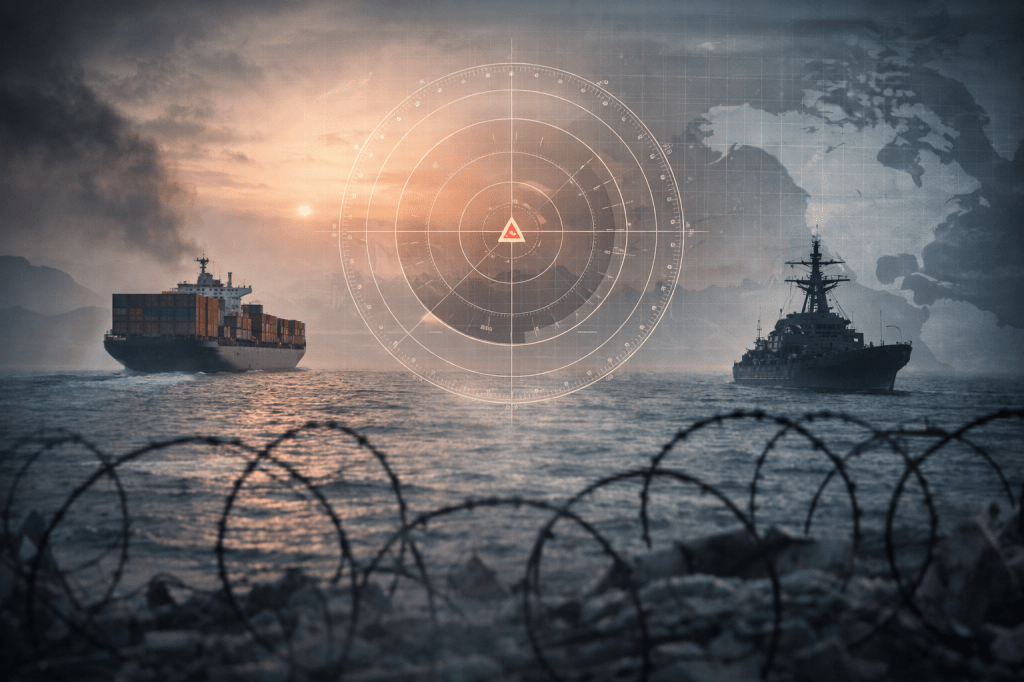
The crisis in the Red Sea is often framed as a temporary disruption—an escalation that can be contained through deterrence, naval deployments, and crisis management. Yet this framing overlooks a deeper and more troubling reality. What is unfolding is not merely a security incident, but another sign of how permanent insecurity has become normalized in international politics.
Since late 2023 and into 2024, attacks on commercial shipping and subsequent military responses have turned one of the world’s most critical maritime corridors into a zone of constant risk. Global trade routes, energy flows, and civilian maritime traffic have all been affected. Despite this, the prevailing international response has remained politically modest, focused on managing immediate disruptions rather than addressing underlying causes.
Insecurity, in this context, is treated as a technical problem. Warships are deployed, routes are adjusted, insurance costs rise, and markets adapt. What remains absent is a serious political effort to question why such crises continue to emerge—and why they are increasingly accepted as a permanent feature of the global system. The Red Sea is not an exception; it is a symptom.
From a peace-oriented perspective, this normalization of risk is deeply problematic. When insecurity becomes routine, urgency fades. Crisis response replaces conflict prevention, and military presence substitutes for diplomacy. The lack of immediate escalation is mistaken for stability, even as unresolved tensions persist beneath the surface.
The Red Sea crisis also exposes a familiar imbalance in international priorities. Global powers mobilize swiftly when strategic trade routes are threatened, yet comparable levels of sustained attention are rarely devoted to humanitarian crises where civilian insecurity is prolonged but commercially invisible. This selective responsiveness reinforces the perception that international concern is shaped more by systemic convenience than by human security.
Particularly troubling is how quickly the language of “temporary measures” solidifies into long-term posture. Emergency deployments linger, exceptional arrangements become routine, and uncertainty is institutionalized. Over time, insecurity is no longer viewed as a failure of politics, but as an acceptable condition to be managed indefinitely.
This approach carries serious long-term consequences. A system that learns to live with constant instability gradually loses its capacity to imagine durable peace. Strategic patience turns into strategic resignation, and diplomatic creativity gives way to habits of containment and deterrence. Peace is not rejected—it is simply deferred without a clear horizon.
The Red Sea crisis should therefore be understood as a warning. Not because it represents the most violent conflict of our time, but because it reveals how easily disorder is absorbed without a demand for resolution. Peace erodes not only through war, but through complacency.
In 2024, the challenge facing the international community is no longer whether it can respond to crises. It is whether it still possesses the political will to prevent them. Without that will, insecurity becomes permanent—and peace increasingly optional.


 Ahmet Tümer