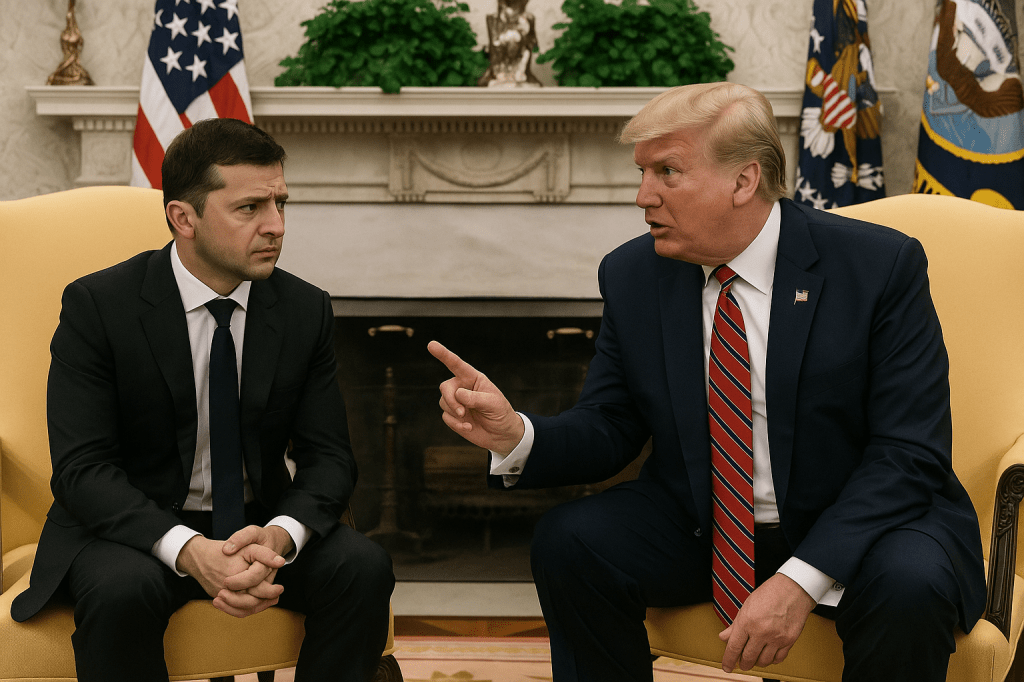
The Trump–Zelensky meeting at the White House this year was remembered less for its substance and more for its tone. When we follow the sequence of events chronologically, it becomes quite clear how diplomatic courtesy and protocol culture were pushed to their limits. In my view, the whole picture said more about the fragile nature of diplomacy than about the bilateral agenda itself.
The visit began in a conventional way. Zelensky was received at the ceremonial entrance together with the press, and at that stage everything looked like a typical official visit. However, once the cameras were brought into the room, the atmosphere changed noticeably. Trump abruptly shifted the conversation to financial aid and expectations, addressing Zelensky in a very direct and rather sharp tone. His remark along the lines of “We give you billions of dollars” is not something we often hear in a formal diplomatic setting.
Then, as Zelensky tried to answer a question, having his words interrupted several times created an unfortunate image from a protocol perspective. It is generally something leaders try to avoid: cutting each other off in front of the cameras, especially when tensions are already high. The added implication that Ukraine should show “more gratitude” turned the moment into a kind of live demonstration of power asymmetry, staged right there in front of the press.
The final step in this chronological chain was Trump’s question: “What would you do without us?” For me, this was the breaking point at which the meeting ceased to look like a diplomatic encounter and started to resemble a political performance. It overshadowed the actual content of the discussions and left behind an impression that sits uneasily with the spirit of modern diplomacy.
Regardless of how these images are interpreted in the domestic politics of either country, the tone used on a diplomatic stage speaks for itself. Meetings between heads of state should not be occasions to rehearse hierarchies, but opportunities to reinforce the ground for cooperation and problem-solving. What we saw at the White House that day, however, highlighted a hierarchical mode of address rather than a partnership-based approach.
In the end, the Trump–Zelensky meeting reminded us once again that diplomacy is nourished not only by content but also by tone. Every time the tone hardens, the space for cooperation narrows. For that reason, I personally do not find the atmosphere that emerged in this meeting very compatible with contemporary diplomatic practice.

 Ahmet Tümer