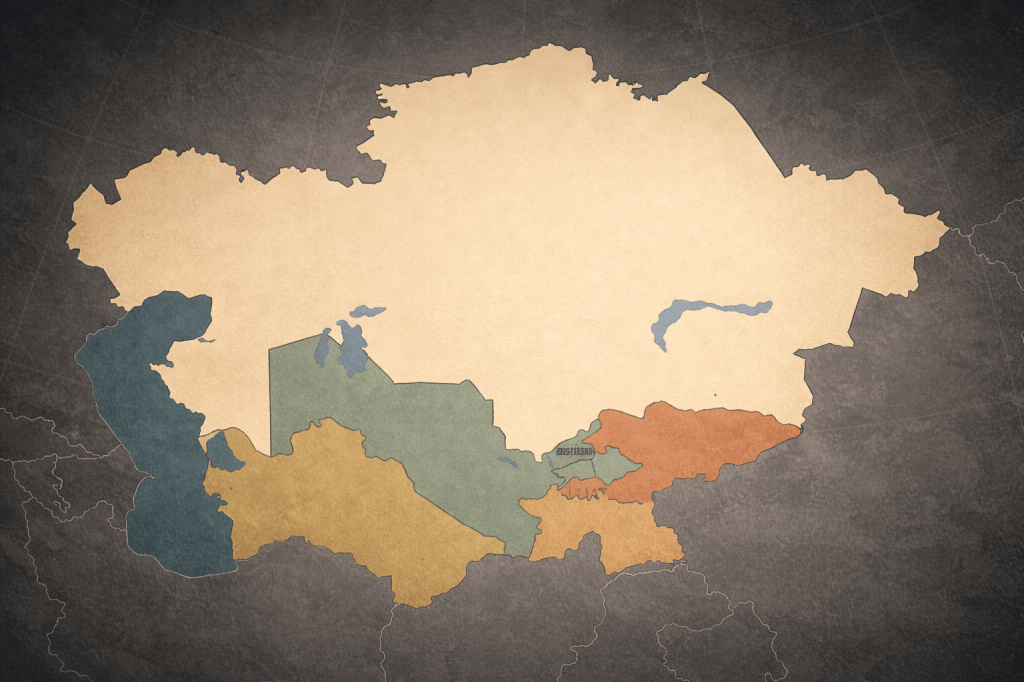
Introduction
By mid-2025, Central Asia is facing an increasingly visible security threat. The March 2024 terrorist attack in Moscow, carried out by elements linked to ISIS-Khorasan, clearly exposed the nature of this threat. The presence of Central Asian-origin militants among the perpetrators points to an ideological and organizational risk that directly concerns the region.
This attack demonstrated that assumptions portraying Central Asia as fully insulated from religious extremist terrorist organizations are no longer valid. Ideology-driven structures have developed the capacity to conduct effective attacks not only in conflict zones, but also in major and heavily protected cities.
The Moscow Attack: A Clear Warning
The 2024 Moscow attack constitutes a clear warning for Central Asia. It has become evident that ISIS-Khorasan has moved beyond being a purely Afghanistan-centered structure and can plan operations across multiple geographies. In particular, the role of Tajik-origin militants in the attack revealed the growing weight of Central Asian citizens within such organizations.
In this context, what happened in Moscow is not a theoretical scenario for Central Asian capitals, but a concrete indicator of risk. Cities such as Tashkent, Bishkek, Almaty, and Dushanbe are among potential targets due to extremist groups’ ideological priorities and operational planning.
The Spread of Religious Extremist Ideology in the Region
The threat Central Asia faces stems directly from the systematic spread of religious extremist Islamist ideology. ISIS, al-Qaeda, and affiliated groups have long sustained recruitment efforts among regional populations.
Central Asian-origin individuals who participated in conflicts in Syria, Iraq, and Afghanistan have internalized the ideological framework of these organizations and gained operational experience. This indicates that the threat is not temporary, but long-term and ideologically deep-rooted.
Returning Foreign Fighters and Local Networks
Thousands of Central Asian citizens previously fought within ISIS and similar organizations. Some have returned, while others continue to operate across different geographies. As of 2025, one of the greatest risks is the potential for these individuals to apply the experience they gained to Central Asia.
In addition, even individuals who never traveled to conflict zones may become radicalized through extremist propaganda. Such local cells can possess sufficient ideological motivation to plan attacks even without direct operational links to organizational centers.
Organizational Structuring and the Risk of Regional Expansion
ISIS-Khorasan and al-Qaeda-linked structures increasingly view Central Asia as a strategic expansion area. The region remains among long-term objectives of these organizations both due to its human resources and its geographic position.
In recent years, Central Asian-origin cells arrested in Türkiye, Russia, and Europe have indicated that these organizations maintain networks extending from outside the region into Central Asia. The Moscow attack demonstrated that these networks possess not only logistical capacity, but also direct strike capability.
A Clear Threat Assessment for the Post-2025 Period
As of 2025, the threat landscape for Central Asia is clear:
- The likelihood that ideology-driven terrorist attacks could spread to regional capitals
- The risk that returning foreign fighters could converge with local cells
- The efforts of terrorist organizations to establish enduring structures inside the region
These risks derive from ideological radicalization and deliberate terrorist strategies.
Conclusion
The primary driver of the rising security threat in Central Asia is religious extremist Islamist ideology. The 2024 Moscow attack showed that this danger is not a remote possibility, but a tangible threat moving toward the region.
Regional states must address this challenge not as a temporary security issue, but as a long-term, ideology-based risk. Otherwise, the likelihood of similar attacks occurring in Central Asian capitals may become increasingly difficult to avoid.
This analysis aims to warn Central Asian governments clearly and directly against the approaching religious extremist threat as of 2025.


 Ahmet Tümer