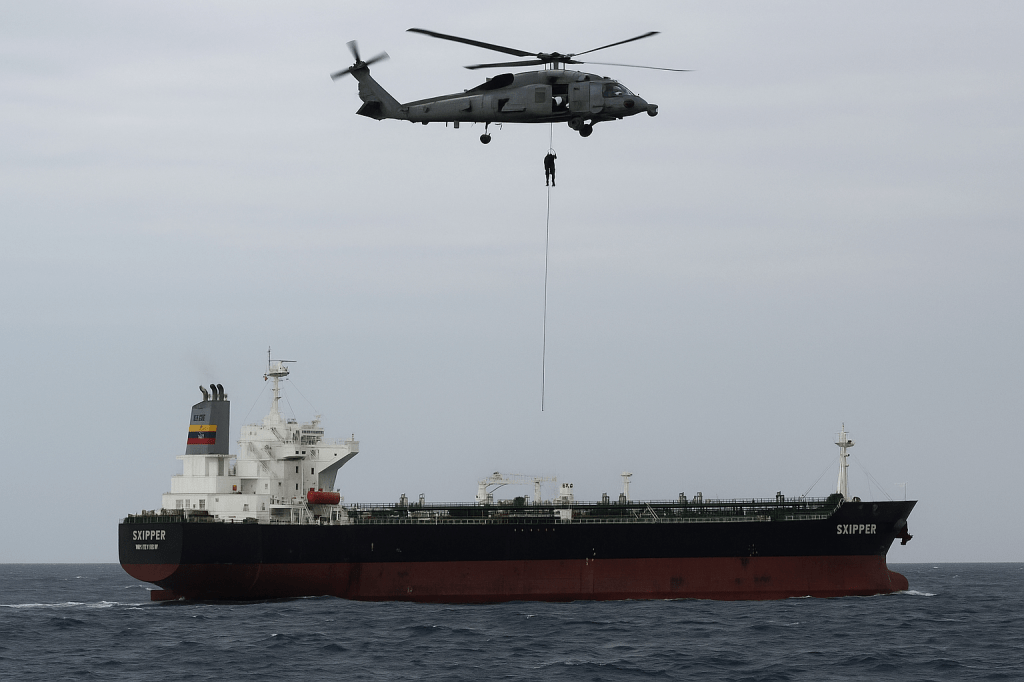
The United States’ seizure of a Venezuelan oil tanker off the country’s coast has immediately raised tensions in the region. Incidents like this often drift into a space where political rhetoric intensifies while legal debates get overshadowed. Yet this is precisely the kind of issue that requires a calm and deliberate examination of international and maritime law.
Washington justifies the operation by referring to its own sanctions regime; Caracas, in turn, frames the act as “international piracy.” Between these two competing narratives lies a more uncomfortable truth: powerful states tend to apply their own normative frameworks as though they are universally binding. There’s an old but accurate observation in international relations: we see the law of the powerful more often than the power of the law. This case is not much different.
International Law and the Question of JurisdictionA state’s authority to seize a commercial vessel on the high seas is extremely limited. The UN Convention on the Law of the Sea (UNCLOS) emphasizes the status of the high seas as “the common heritage of humankind,” restricting states’ ability to exercise enforcement powers. Piracy, slave trading, unauthorized broadcasting, or situations involving stateless vessels constitute narrow exceptions.
From this standpoint, even if the United States relies on its domestic laws and sanctions, such measures do not automatically create legitimacy under international law. Sanctions enacted unilaterally lack universal enforceability. No state—especially one already in a politically adversarial relationship—is obligated to recognize another state’s domestic sanctions regime. In this sense, a military seizure of a tanker falls into a legal space that is not merely gray but rather notably dark.
Power Projection and Creating Facts at SeaBeyond being a conventional example of power projection, the operation reflects a broader strategy of creating “facts on the water.” By targeting a vital artery of Venezuela’s economy—its oil transport—the United States sends a subtle message to other regional actors: “Our sanctions are not just policy statements; they can and will be enforced.”
Remaining entirely neutral here feels unrealistic. The international system maintains stability only to the extent that the rule of law remains intact. Once states begin interfering with each other’s commercial vessels with increasing ease, the precedent becomes dangerous. Today it’s a Venezuelan tanker; tomorrow it could be another nation’s vessel. Where exactly will the line be drawn?
Conclusion: Every Step Away from Law Expands UncertaintyThis incident is not merely another chapter in the long-running tensions between Washington and Caracas; it is a snapshot of a global environment in which international law is repeatedly tested. As states rely on domestic legal rationales to justify actions affecting foreign assets, the international legal order weakens and systemic uncertainty grows.
Staying impartial does not require suppressing legitimate concerns. Any unease expressed here stems not from affection for Venezuela or hostility toward the United States, but from a broader worry: actions that erode the framework of international law ultimately make the entire global order more fragile.
At the end of the day, the question is simple: Will power prevail at sea, or will the law? The answer affects far more than this single incident—it affects all of us.


 Ahmet Tümer